
Becoming Racist
In Africa, something will surprise you.

The Gambia-Senegal border crossing in Karang is tough. Once you’ve got used to gentle character of the Gambians, the confrontation with the Senegalese mentality is brutal. A crowd of simcard sellers, currency dealers, beggars and scammers surrounds you. They are aggressive.
A man wearing a khaki shirt that resembles uniform orders you to approach him. With a commanding gesture, he directs you to the Gambian passport control. He waits for you until you’ve done with the stamp, and then he orders you to the Senegalese passport control. You are done in fifteen minutes, and he is still there. He then orders you in the taxi. Only then do you realize he is not a true officer but a common swindler, whose presence should not even be tolerated. He is there to force you into an overpriced taxi of his friend.
The motorbike taxi driver asks for 6,000, which is six times the price. You hesitate, and that’s your mistake. Some strangers (police officers? friends? scammers?) approach you demanding sharply: “pay him 6,000”. You refuse and start to walk away. The angry taximan follows you closely for a while until you yell at him.
You want to run from this horrible place but unfortunately you need a sim card. At the simcard stand, you reach inside your pocket. In an instant, twelve begging children appear from nowhere. This is not Gambia and beggars don’t smile. They just say aggressively: “argent” [money]. You look at the seller and he looks at you: what’s the problem? You finally say: “I am not going to open my wallet”. He chases the kids away.
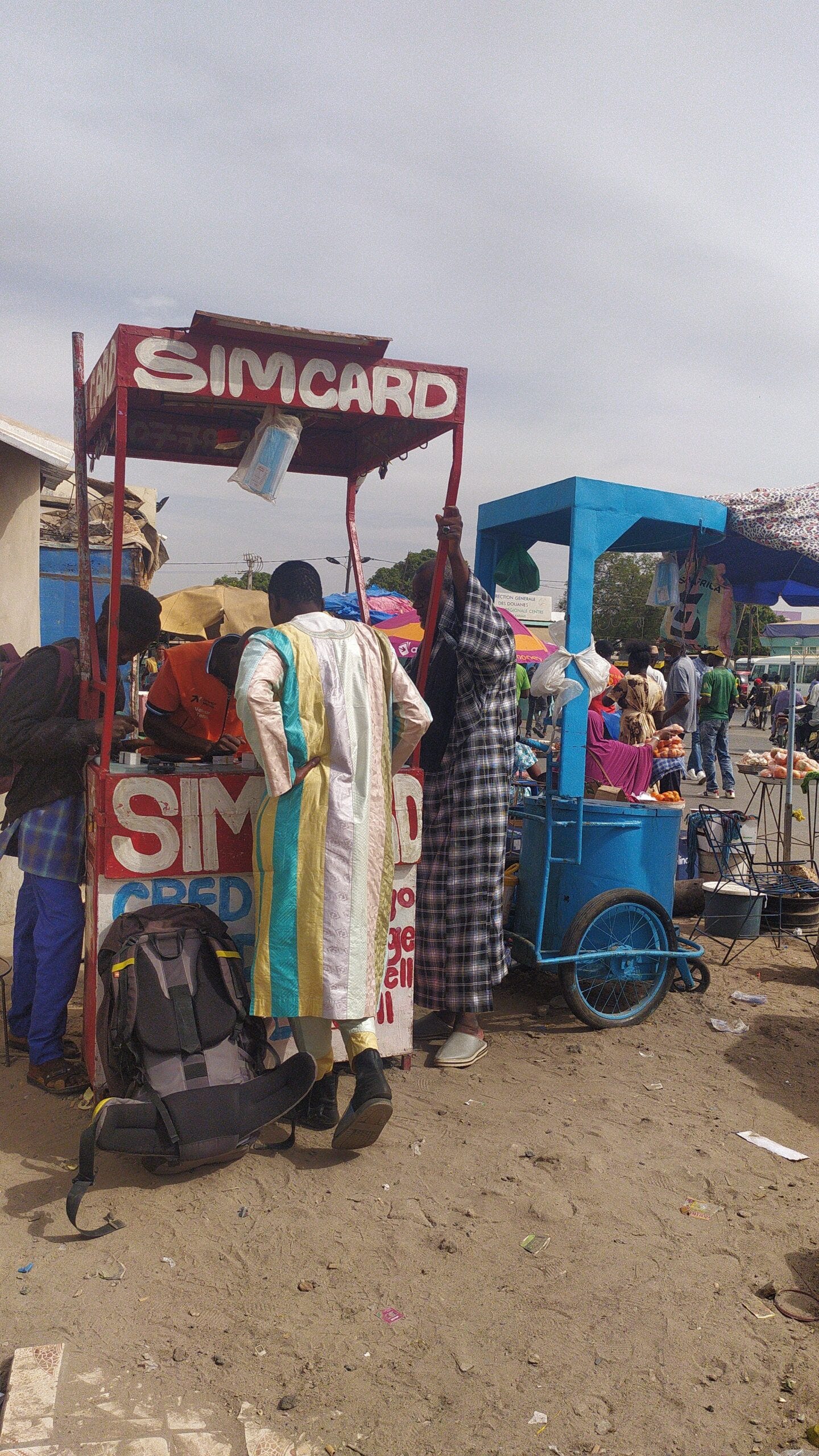
Nearby, black passengers cross the border without much trouble. Only the whites get assaulted. The customs and police officers do not react. Most assaults happen in the no-mans land (the 300-meter zone between Gambia and Senegal border posts) so you don’t even know who would be in charge.
***
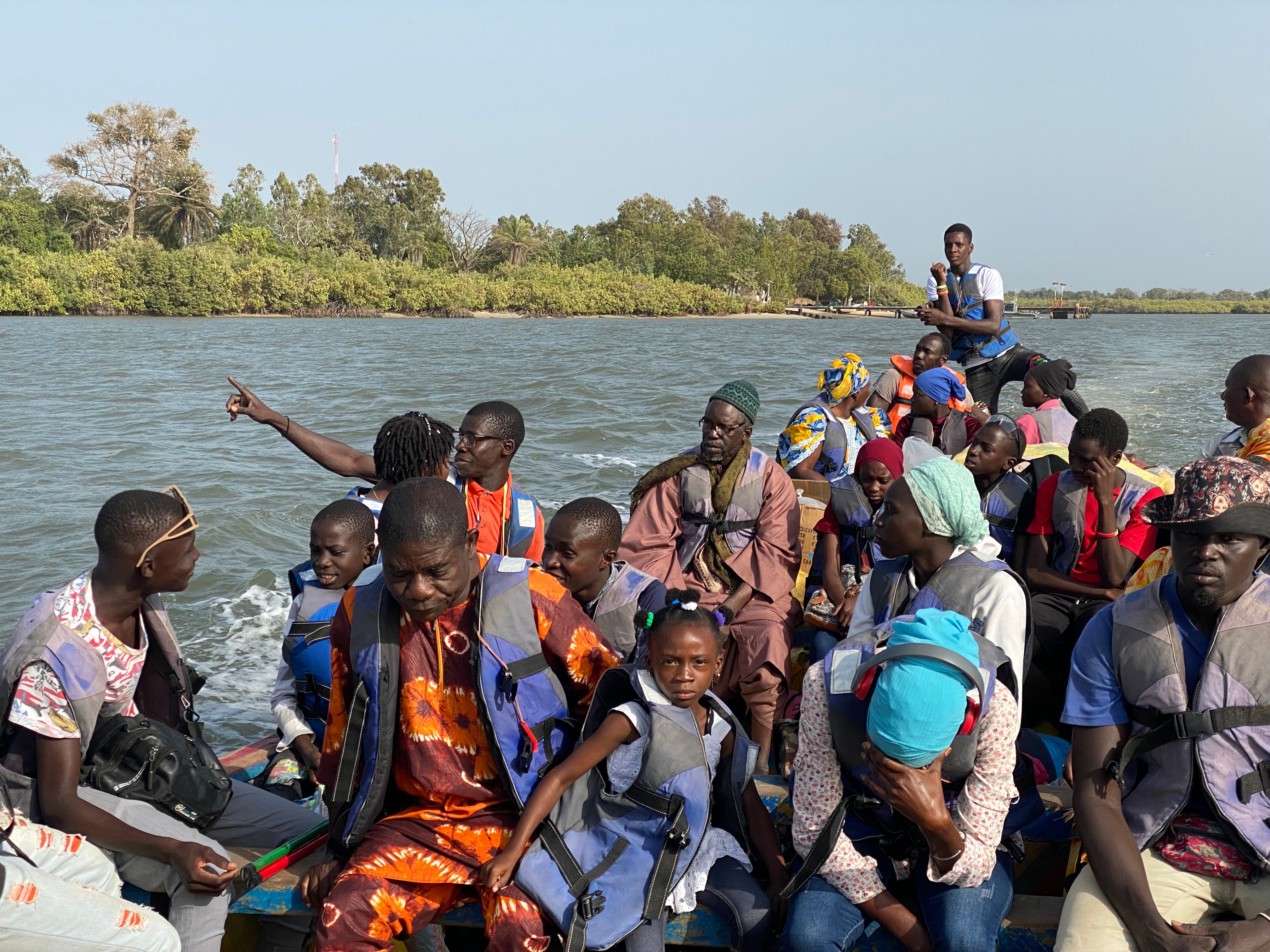
A day later in Saloum Delta, Senegal I ask for transportation to the island of Sipo. The boat owner offers 20,000 CFA (30 EUR), for a private boat ride. I refuse and decide to wait for shared ride. Half an hour later a local boat comes with local people inside. I approach that boat too. The price offered to me for shared ride is the same: 30 Eur. I cannot believe this. I ask the lady in the boat how much she pays. “Nous, on ne paie pas. Nous sommes les noires” [we do not pay. We are Blacks].
I later share this experience with Gambian friends. Amadou, a Senegalese shopkeeper who lives in The Gambia gives me this intriguing commentary: “Nous, les gens dans les pays francophones, nous sommes plus violents” [We, the people from the French-speaking countries we are more aggressive] I did not understand this comment until many days later, when I better observed and understood the peculiar Senegalese-French relationship and the resulting cultural mix. The topic would need a separate story; for now I will just say that I find his judgment fair.
“There is No Racism in Africa”
Many people think of racism in the context of the Global North. My experience is contrary. During a few short months in West Africa I’ve seen more racial discrimination than anywhere in Europe. The African racism has a peculiar trait: no one will call it by name.
Africans, too, commonly associate racism with what white men did to the Black people: colonialism, slavery, and apartheid. A racist is defined not as “someone treating others badly because of their ethnicity”, but as “a bad white person”.
I often heard: “there is no racism in Africa”. I felt my dialoguers were proud of this phrase, which, unfortunately, was far from truth.
It has many angles.
The “no-racism” of blacks against blacks
“The Smiling Gambia” tourist slogan is not an exaggeration. Gambians are exceptionally friendly and yes, they smile a lot. In the Gambia, I often heard: “All Africans are brothers”.
Curiously, it is precisely there where I witnessed racism of blacks against the blacks.
In the Gambia, the main town does not even have name. Unofficially, some call it Kombo. It interconnects the neighborhoods of Serekunda, Kololi, Bakau and Kotu. Many poor inhabitants of Kombo are immigrants from the forests (forestiers) of Guinea Bissau, Guinea (in the common language Guinea Conakry), Sierra Leone and even further. Most white visitors do not notice these migrants, especially if they come to The Gambia for a few weeks and all locals appear the same to them. But after a while you notice differences in appearance between the Wolof, the Fula, and the Mandinka. In fact, The Gambia is ethnically highly diverse. Then, little by little, you start seeing more. It strikes you that while most Gambians are talkative and smiling, some people don’t smile and don’t speak.
The forestiers can’t speak English.
Some speak a dialect of French. They remain the pariahs in Gambian society. Even though they are often ready for work, they’d have trouble finding any or end up being paid a fraction of the regular Gambian salary, which is already very low. The stories I heard from this community were about exclusion, dishonesty toward them, and a glass ceiling preventing them from improving their lives. I sensed that the smiling Gambia was a place of complex social hierarchies, quite invisible to tourists and impenetrable even for longtime white residents.
Most white visitors to Gambia are British. The immigrants from Guinea Bissau or Guinea Conakry don’t speak English. End of story.
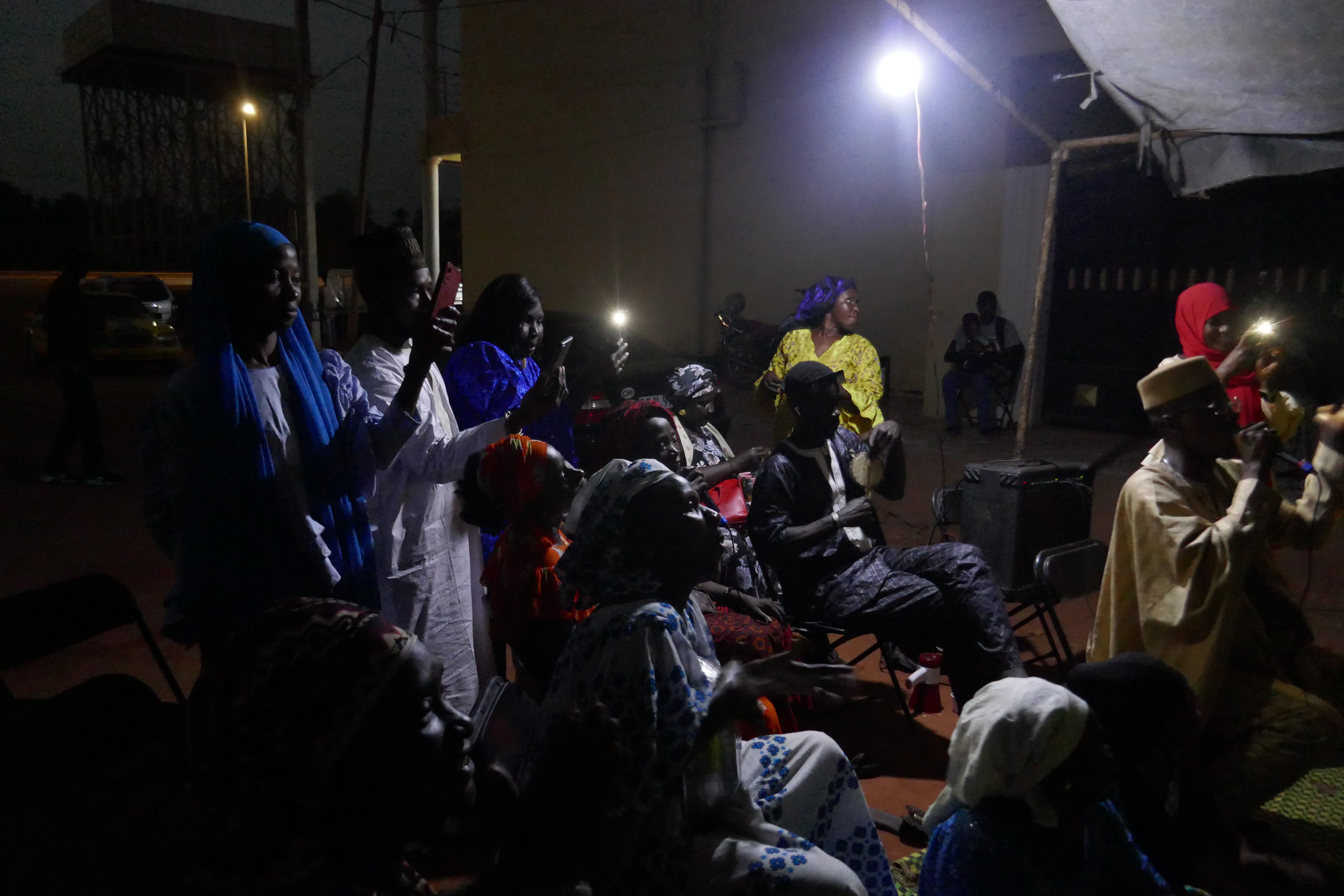
The “no-racism” of blacks against whites
Now let’s move to Senegal.
It starts with money. The whites are generally and commonly expected to pay considerably more for services not because they are foreigners, but because they are white. In tourist areas, often services are free for blacks, but paid for whites. One could argue this isn’t racism, but rather economic opportunism directed at perceived wealth. Unfortunately not. One day in Fadiouth, Senegal’s attraction sometimes compared to Venice, I observed how the white backpackers were stopped to pay, while affluent weekend visitors from Dakar entered free. Whether it’s an official policy or personal whim is hard to say - people don’t wear uniforms and you never know whether you are talking to an officer, his cousin or a con man.
I noticed with some surprise that the British or French tourists generally accepted this and just paid whatever was asked, as result of their factual or imagined colonial debt. However, Europe is not what it was a hundred years ago. Most contemporary Europeans have nothing to do with the colonial burden - on the contrary, their countries were themselves subjugated by the colonial empires of that era. The people I’ve met in Senegal, naturally, did not know that.
What many tourists don’t notice is how they are addressed with disrespect. I sometimes felt that black children were taught respect for elders - but only if the elder was black. I wrote more about it here. It also happened to me that an arrogant shopkeeper, addressing me directly in Wolof while looking straight in the eyes, used strong, offensive language which he would not use if the client was local.
Needless to say, this would not happen often. The vast majority of shopkeepers were friendly and reasonable.
Cultural defensiveness
Another subtle, but very annoying form of racial discrimination (or “cultural defensiveness”?) against the whites is the denial of voice and opinion. Once, researching the topic of FGM/C described here I witness a conversation between a white female international worker and a Gambian government expert, well-educated and connected. His argumentation soon became personal. The woman was accused of bringing a biased, colonial perspective. Interestingly, she had only repeated the arguments and horrific stories she collected from the black migrant forestiers in the slums of Kombo. Still, because she was white, it did not count. Would it count if the officer heard it directly from the black victims?
Another time in Casamance, southern Senegal I ended up discussing the local magic rituals I had witnessed. My black interlocutor would interrupt me, saying I had offended “his people”. Interestingly, he was a foreigner from distant Cameroon - which was far away both culturally and ethnically. The man did not even speak the local language, neither Wolof nor Diola, but communicated with the locals in French. However, since I was white, and he was black, he felt permitted to somehow control my behavior in a paternalistic way. I was on “his” continent.
That peculiar sense of African unity, often defined in opposition to the West, is indeed there. It’s sometimes ironic: many villagers don’t know what Africa is. However, in tourist destinations I heard local bands performing songs about Africa. Whether the songs were made especially for tourists, this I don’t know. In contrast, I never heard a song about Europe performed in Berlin, Paris or Barcelona.
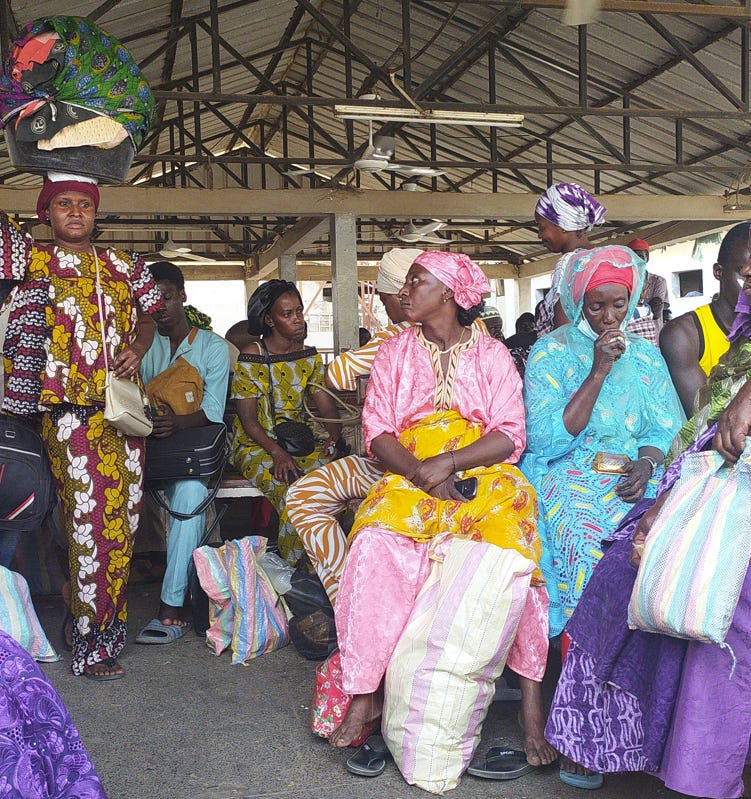
Becoming Racist… not
African racism, or broadly - racial discrimination has a peculiar flavor: no one will call it by name. But it is there.
However, every society is diverse. In any corner of the world, you will meet people you can instantly trust and have a good time with, as well as scammers, grifters, and those who will suck out your energy and put you in trouble. And racists. Africa is no different.
My overall experience in West Africa was overwhelmingly positive.
Regarding the boat incident I spoke about, it did not repeat. I later had many more boat passages that went nicely. In another boat (this story) I paid twice as much as locals for the boat, which I did not mind. The boat had been purchased and collectively owned by the village association. People from outside, blacks and whites alike, had to pay more. It made sense.
Also, the phenomenon of racial discrimination differs by country and region. In Senegal’s tourist destinations you’d confront it daily. In remote rural areas, rarely. By contrast, the Gambians also do it, but often in a friendly, less aggressive manner. As someone once put it: In The Gambia, a white man is the rich uncle. In Senegal, he is the white loser. Then, among Cape Verdeans I have not noticed much of racist dynamics in conversations. Other African countries may be very different. I’ve only seen a small portion of the continent.
Once confronted by a racist attack, one almost automatically “becomes racist”. It is a natural, defensive behavior.
Don’t.
But also, don’t accept. Whether you’re white or black, you have equal right for respect and dignity.
As a white man living and working in Uganda for over 10 years I completely agree and I have been in many similar situations. Here they speak English but in their local languages it seems they have no friendly way of asking things; children will come up to you and say "give me my money" or "give me my sweets". The racism is off the charts here; this tribe is stubborn, this tribe is untrustworthy, this tribe.. The many times I have heard "you whites..", I can't even count it on 100 hands. I have gotten used to the mzungu (white man) price and I have almost become used to people calling me mzungu, even though it keeps being annoying.
The biggest problem I have is with how difficult it is to trust someone. Almost everyone I have encountered have tried to take advantage of me, steal from etc etc. It makes life so tiresome and frustrating, especially since I am here starting projects to help children get better nutrition and I pay it all from my own savings and friendly donors. Sure, I am not poor when next to an average villager but I am definitely not rich. Not even close.
The last part that can be frustrating is simply counting on someone. "I will be there tomorrow in the morning" basically tells you he might come somewhere this year. When you call around noon where he is, he is always "on the way" but even then it can take another week. Ah.. Now that I am ranting, let me add this one; when you fail what you were supposed to do or you break something, it is local customs to just keep quiet until the person confronts you. Freaking annoying. I just explained it to a staff member this morning; if you do this, instead of one problem you have created two. Because not only is the thing broken but now I am more annoyed because you kept it from me.
Let's end this rant in a positive way; the country is beautiful, the climate is great and on a superficial level the people are very friendly.
In the particular case of The Gambia vs. Senegal, I found The Gambia to be more difficult, with respect to fighting off scammers, etc. I had some strange experiences there that I rarely have in other parts of Africa. It can be the case that one traveler's experience varies from another, it can be luck of the draw (especially at borders).
In the more general sphere of racism, or ethnic mistrust, there is certainly plenty of that around. But what I suffer on the continent in terms of disrespect really feels minor and unimportant. I fight to get a good deal on taxis, etc, just like the Africans I'm sharing the ride with. And I can't count the times people have gone out of their way to help me, in situations where I was at a disadvantage due to not knowing exactly how everyone is supposed to buy tickets, get a meal, etc.